I attended a conference last week and, especially, a research development workshop. In this workshop, one of the discussants commented on a paper that the author (not me) had to make it clear whether the firm was “entering a new market or only launching a new product in an existing market.” That comment totally confused me, so I had to ask what is “a market” – is there really a difference between “supplying a new product in an ‘existing’ market” and “entering a new market”? And how are these actions different in kind (not just degree)? [Read more…] about What is a “market”?
On Lachmann’s “Capital and Its Structure”
 This book [pdf here] provides a wonderful discussion on the theoretical implications of treating capital [goods] as heterogeneous. It may not seem very radical, since everybody knows that a hammer is not exactly the same thing as a ladder, an airplane, or a machine. But to economic theory, this is a radical move. Only in the Austrian school is capital heterogeneity fully embraced and developed, and Lachmann’s Capital and Its Structure is the greatest contribution in this strand of the literature.
Lachmann discusses the functions of different capital formations and derives the obvious truth that capital is heterogeneous, which means it has different uses and therefore multiple specificities and complementarities, which in turn implies that capital can be combined in new and unique ways, which can only mean that capital exists in the form of a structure. [Read more…] about On Lachmann’s “Capital and Its Structure”
On Bergh’s “Den kapitalistiska välfärdsstaten”
 A nice summary of the rise and fall of the Swedish welfare state, “the capitalist welfare state” to the author. The book covers the “golden years” approximately 1870-1970 and discusses how and why Sweden could go from being one of the poorest to one of the richest countries in the West – while supporting an expanding welfare state. He also discusses how everything got messed up in the two decades 1970-1990, and why the welfare state as well as Swedes’ relative prosperity could not survive this institutional change. Overall a thoughtful and nice summary of the rise and fall and renaissance (?) of the Swedish welfare state – and what are the reasons for its relative success.
On Santesson-Wilson & Erlingsson’s “Reform”
 A nice collection of essays summarizing the cutting edge political science institutional research on what drives political change. As a rather new-born economist, I can’t help thinking that research in political science often tends to become more of a narrative than a structured pursuit of knowledge – and that this sometimes (as was the case in a couple of the essays) makes the analysis a bit shallow. Some of the points were well taken, some conclusions – especially when connected to the historical evolution of the institutional framework of political rule – were very interesting and enlightening, whereas some essays were purely descriptive and in lack of analysis. Overall a nice collection of essays trying to summarize the institutional study of political change; it may be[come] a nice starting point for future research.
On Menger’s “Principles of Economics”
 Mises supposedly said that Carl Menger’s Principles was still (at the time) the best introduction to Austrian economics. This is certainly true, but I would go further than that. The Principles is not only an introduction to Austrian economics but a great introduction to sound economic thinking. Whether you agree with “Austrians” or not, and whether you have successfully finished a graduate degree in economics or not, you will still learn a lot about economic reasoning, the logic of social relations, and – especially – the economic way of thinking.
Menger’s treatise is a very easy read, is exclusively written in beautiful prose (no math), and focuses on understanding how the market functions through first understanding how and why individuals choose to act. But it is not simply an overview of concepts; it is a thorough analysis of the bases and starting points for economics as well as the understanding that necessarily follows. [Read more…] about On Menger’s “Principles of Economics”
On Boettke & Coyne’s “Context Matters: Institutions and Entrepreneurship”
 A nice introduction to the study of functional entrepreneurship and the context in which it exists and is exercised. But emphasis should be on the word “introduction” – this is not a heavy analysis in scholarly style, but rather a quick overview of the topics studied re: both entrepreneurship and institutions. I’m not sure exactly how this essay, which is no doubt beautifully written and easy to grasp, should be evaluated or valued: exactly what is the audience?
Boettke and Coyne are scholars in the field, but while they do cite a number of scholarly studies their own work is but a lay man’s introduction to the field, its foci and the questions currently discussed. Other scholars in this field or with an interest in entrepreneurship, new institutional economics, institutions, or the theory of the market would not have much to gain from reading this essay.
On “Freakonomics: A Rogue Economist Explores the Hidden Side of Everything”
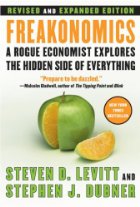 Freakonomics was an immediate success when hitting the bookstores back in 2005. I guess its melding of pop culture with economics was something unexpected, long awaited, and seemed interest in the market. Granted, the book is an easy read with plenty of provocative examples and a clear logical reasoning that is scarce both on television and in many classrooms. However, it seems the authors choose examples primarily to provoke rather than actually show what economic reasoning might contribute to our understanding of the real world. In fact, much of the discussions in the book are but pop-style stories based on correlations found through data mining. The book thereby demotes economics to simple and inductive data analysis and data mining, which is pretty far from the view of economics as a purely deductive science of human action we should be used to. Perhaps this is simply a natural “next step” from the overly mathematized economics of today, but in many of the cases discussed in Freakonomics the authors fail to show how it is economics that has guided their quest for understanding the world. It might as well have been statistics or any kind of fumbling in the dark. In conclusion, economists of the traditional variety may find this book slightly repulsive due to its data-guided reasoning, while economists of the more recent and inductive data-bending kind might find this both fascinating and inspiring. The non-economist public will find that it is an interesting and provocative read, but should not read it hoping to learn economics – there are many much, much better books for that purpose.
On Kirzner’s “Competition & Entrepreneurship”
 No doubt, Kirzner is an excellent thinker. However, I do get a feeling that his theory of entrepreneurship is somewhat limited. As an Austrian economist, I do not understand why he necessarily limits entrepreneurial action to decisions following alertness to opportunities. It seems his market process consists of these decisions – but that the decisions are instantaneous. In this regard, Dr. Kirzner seems to escape the effects of time; after all, a decision is not what makes entrepreneurial profit – it is the decision followed by action. Also, since a decision and the carrying out of the action cannot happen instantaneously, there is a possibility for making errors (losses) through bad estimation/judgment or simply because one has limited knowledge of the future. [Read more…] about On Kirzner’s “Competition & Entrepreneurship”
On Richter’s “Pictures of a Socialistic Future”
 Unfortunately, this book’s strength is just as advertised: it is old, yet accurate. The story itself could be a lot more enjoyable if the author had not written it in such a heavy and inaccessible language. Don’t get me wrong, the book is not written badly and is also not very hard to read. The problem is that it is a story in semi-diary form, which requires much simpler language.
If one thinks of the fact that this story was translated to English already in 1893, the whole thing is so much more enjoyable. But the reader does best in remembering this fact throughout the book. The story line is okay, the portrayals of people and situations are also okay. But what makes this book extraordinary is that it describes a socialist society and how it degenerates into social unrest, chaos, and is subject to a counter-revolution as well as war – written long before there were any socialist countries! [Read more…] about On Richter’s “Pictures of a Socialistic Future”
On Kirzner’s “Perception, Opportunity, and Profit”
 Kirzner’s Perception, Opportunity, and Profit is a collection of essays, previously published and unpublished, on a number of issues relating to the well-known Kirznerian concept of entrepreneurship. As such, it supposedly offers a clarifying discussion on what is meant by “pure” entrepreneurship, alertness (as opposed to innovation, judgment, etc.), and, perhaps the most provocative part of the Kirznerian conception of entrepreneurship, how the entrepreneur is not necessitated any ownership.
Unfortunately, after reading this book I am still not sure how to answer these questions. It is not clear to me how entrepreneurship is usefully separated from the ownership and control of resources used to realize the profit opportunity discovered. [Read more…] about On Kirzner’s “Perception, Opportunity, and Profit”